This kind of manufacture, with which we realize the greater amount of our jewels, needs long time and several steps to be realized, but helps us in having particular shapes and bulkier objects. Besides it's only with this technique that we can obtain that particular surface and colour of gold we call blank gold.

   How the word suggests, with this technique we use wax models. These ones are directly carved from a block of wax or injecting some liquid one into apposite dies previously prepared. 

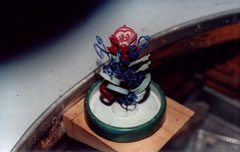
Wax Tree

Being this process of melting rather long we don't make it for a single jewel but we wait for collecting a greater number of pieces. When they are all prepared we assemble them together in the so-called "wax tree". From a rubber disc, called a sprue base, the wax "trunk" springs up and from it, just like in a tree, the "branches" come out. At the extremity of them we apply our future jewels.

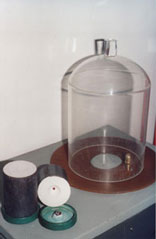
   A first stage is done. The jewels have been ideated, carved out in wax and now assembled in a unique structure. The next step consists in investing the wax tree with a specific plaster for melting. On the sprue base we make rise a steel cylinder so to contain the thick plaster coat which completely wraps up the wax models. Just to avoid the presence of undesirable protuberances on the jewels during the melting, we take care of eliminate some eventual air bubbles from the  

liquid plaster. To make that we use a machine to produce the vacuum, the so-called "debubblizer" (see the photo here near).

The so obtained plaster cylinders must rest for some hours so to completely solidify. Then we remove the sprue base (its task was that to support the wax tree, from one hand, and the metal cylinder to the other; now it's the solidified plaster to unify the structure) and proceed to dissolve the inner wax by heat. You can see how the wax models are completely lost but, in their place, they leave a void shape in which finally sprue the melted gold.

   The plaster cylinders, after being empted from the wax, must stay some hours into an oven, passing from different temperatures for sharp periods of time. This cooking process confers to the plaster the property to endure to the high 
Vacuum Pomp

temperature of the molten gold: 1053 C°!

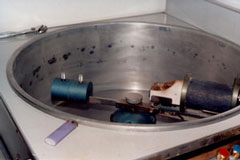
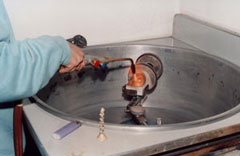
   We can now start the final passage of the casting. We take off a cylinder from the oven and put it on the arm of a machine; in a nearby crucible we melt the gold alloy with the help of an oxypropan torch and, with an easy movement, we put in action the machine. It's a mechanical one, even if there exist electrical ones, based on the principle of the centrifugal force. The arm with the spring is earlier loaded and when we subsequently release the stop it starts to move at high velocity. The melted metal, passing through a hole, is driven in this way, with a high pressure, from the crucible directly into the plaster cylinder filling up every void shape. We can now dissolve the plaster in water and admire the final work. 


Centrifugal Casting Machine

Oxypropan Torch


   We want to notice how, being several steps of working, it's not so impossible to fall into some accident. The final result of the work isn't given for expected; the risk of seeing some days of work vanished, with some unique models, always subsists. It's only the long experience in the field to confer sharpness to the movements, to the dosages, to the right times, so as to always obtain a quality product.   

Gold Tree

 After having cleaned up the metal tree from every residual plaster and provided to a primary deoxidation, we assist to the faithful and final transformation from the original wax models into metal objects. Now we pass from the forge room to the working bench where the artisan jewel, before being worthy of this name, must be subjected to the processes of rough-shaping and finishing touch.

   It's between the craftsman's clever hands that the jewel takes the final shape. It must be sawn, rasped,

emery papered, soldered, made precious with different-colour gold or gems and finally polished, ready to exalt the beauty of every woman.

   If anyone is interested in more particular aspects of this job, we really suggest to read the exhaustive book on the matter :

bulletModeling in Wax for Jewelry and Sculpture by Lawrence Kallenberg, Chilton Book Company, Radnor, Pennsilvanya,1981.

Other books suggested from the same publishers are:

bulletThe Design and Creation of Jewelry by Robert von Neumann
bulletJewelry: Basic Techniques and Design by Alice Sprintzen