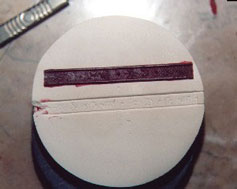
Dies are used to make more copies of a unique object. It is so possible to pay off the costs of the primary model. In our job they are very useful in realizing modular jewels, such as kettles or armlets, of which we can carve the model of a single link.
There are two kinds of die, completely different one from the other:
 |
Plaster die |
|
Rubber die |
For making a plaster die we realize a thick plate with this material and then we carve on its surface, using specific tools, the shape we need. It is useful for flat models, such as medals, plates for armlets and every other kind of plates.
The difficult, in this work, is that we are carving at the negative. So, during the working, we often control the result of the figure at the positive by pressing some plasticine in the hollow.
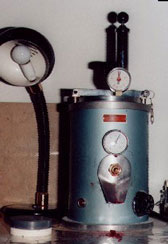
We remember you that we are dealing with dies for the lost-wax casting so we are not going to cast inside them the melted gold, as normally people think, but some liquid wax. To realize this last step we use a specific machinery called "wax injector"; sometimes, especially with wider dies, is more useful to melt some wax in a pan and pour it manually in the hollow of the die.