|
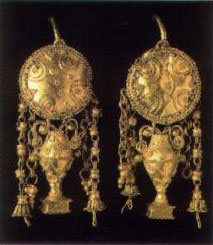
With the term "blank gold" we intend the working that better distinguishes NIGI's jewels. If you have already seen some of our photos you'll surely have noticed how the creations immediately appear different from common jewellery. This last is mainly produced with polish gold, sometimes "scratched" on its surface with techniques such as glaze or sand-blasting. Normally the jewel just cast has an unrefined, porous, slightly rough surface. The colour, too, appears of a different yellow, a warmer one (obviously after a primary working to eliminate the black colour caused by flames). It's just this effect we define "blank gold", because the surface hasn't already treated with other workings. We don't intend the fine gold, as it's called the pure one (title 999,99%0). In our case the original metal has already been alloyed in the title 18 Kt. and undergone to the casting process. The NIGI's jewel worked in "blank gold" is still something more: it's the product of a working whose result is the final polishing only of some parts of its surface, generally the relief ones, while some others are left in their original just-cast effect. The final result is an interesting contrast of colours and shadings which, for a particular play of light and shadow, permits us to create a new design. The aspect of the jewel is not delimited by its external shape but comes out from all its surface. Don't believe that this working is less difficult than the traditional one, on the contrary! While with a completely polished jewel we work the total surface, in the case of a blank-gold one we have to pay particular attention to work (with limes, emery-paper, polishing-brushes) the only desired part of the surface. In fact if we simply scratch the blank-gold part it will never come back. The "blank" gold can only be obtained with the lost-wax casting and every type of working on its surface is an irreversible process. Generally the blank parts are lower than the polished ones so not to ruin them while wearing the jewel. This particular finishing touch was typical of the ancient goldsmith's laboratories and we like to propose it again even if in a more modern style. It's a semi-polish working already proposed by big and famous Italian firms with the name of "Etruscan gold". In this occasion we permit not to accept the choosing of this term in that not properly fair. The Etruscan, people of fine taste and skilled goldsmiths, used, for their jewels, a very peculiar working: the granulation. On a thin gold plate (not cast!), they proceeded by soldering several decorations in the shape of little beads, twisted threads, and so on. As you can easily see from the photo below, this typical example of Etruscan jewellery is completely different from the modern working called "blank gold". |
|
|
|
|

