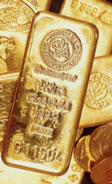
Up to the end of 1800 the great deal of gold came from secondary layers;
nowadays it mainly derives from rocky layers containing at least one gram
of gold per thirty tons of rocks. In minor part gold also derives from the
excavation of other metals.
The greater quantity of drawn-up gold comes from the mines of South
Africa. Other important areas of gold mines are: the ex Soviet Union, the
Canada, the Brazil, the United States, the Australia, the Ghana and the
Philippine Islands.
In Italy there are either primary layers (in the Alps) ore secondary ones
(the alluvium of the Po, the Dores, the Ticin etc.) but not so
remunerative for the extraction.
Pure gold is an inoxidable, ductile and malleable metal, so it is easy to
work. What with this reason and its color like that of the sun, it has
been very appreciated since ancient times.
Nowadays there are still some populations which produce jewels in pure
gold, such as in the Arabian states or in Asia. In reality this metal is
rather soft, easy to wear out, so not so fit for everyday jewellery. For
this reason it is generally melted with other metals which can ensure it a
certain endurance; we obtain the alloyed gold.
In Italy the production of jewellery mainly uses 18 gold carats (Kt). The
title of the alloy can be expressed either in carats or in millesimals; in
this last case we speak of gold 750%0
in that 750 parts on 1000 ones consist of pure gold while the remaining
250 parts are of alloy.
The more essential and ancient alloy is composed of pure silver and
copper. It is easy to understand how the introduction of different
components make loose the natural color of pure gold. More copper we use
in the alloy and redder is the final color of our 750%0
gold, typical, for example, of the gold of half-a-score of years ago. More
silver than copper in the alloy confers to the gold a pleasant yellow
color, as you can see in our jewels.
Several factories, in order to obtain a gold easy to work with
machineries, introduce other metals in the alloy. The NIGI firm, in
respect of ancient tradition and pureness of the product, uses for the
alloy of its gold exclusively pure silver and copper, in a personal
proportion which characterize the particular point of colour of its jewels.
The low carat gold (14 Kt.=585%0;
9 Kt.=333%0)
is commonly used in central and north Europe or in the States; it contains
more copper in the alloy and for this reason is easily oxidable.
As we have seen the typology of the metal inside the alloy determines the
colour of the alloyed gold. So, if we use only pure gold and pure copper,
without any silver, we obtain the red gold. An alloy with only pure
silver creates the green gold. The white gold is obtained
melting together pure gold with some other metals such as palladium, zinc
or nickel. This last causes allergy to many people and for this reason it
will be soon avoided from jewellery. The white gold is a hard metal, more
difficult to work and with a not nice colour, slightly grey or yellow,
according to the alloy. For this reason the object is finally dipped in an
electrolytic bath with rhodium .With the passing of time the rhodium tends
to use up, so a white gold jewel needs a major care.
Other possible colourings
of gold are the pink gold or the blue one (this last is
obtained melting together pure gold and iron). Some firms are proposing
these particular coloured golds, especially with stones with the same hue:
pink sapphires, pink diamonds, blue diamonds, coloured tourmalines and so
on.
CURIOSITIES